
.jpg)
History of GI Pipe and Wire Rope Shadenet House
· In
year 2010, Lots of wine purpose plantation was failed.
· Farmers
were moving towards the erection of local Shadenet Houses.
· At
that time, few farmers contact us in search of good quality Shadenet House
Structures.
· We
contacted several Israel and European companies.
· Israel
company, P moram explains us Israel European shadenet technology
· In
year 2010, We Imported India’s First GI Pipe & Wire Rope Shadenet House
with the help of Sahyadri Farms.
· For
erection of structure Israel technician arrive in india. We train our staff and
erection team under Israel technician.
· At
that time project is also supported by National horticulture board.
·
Further, for Study purpose of GI
Pipe and Wire Rope structure we visit Israel.
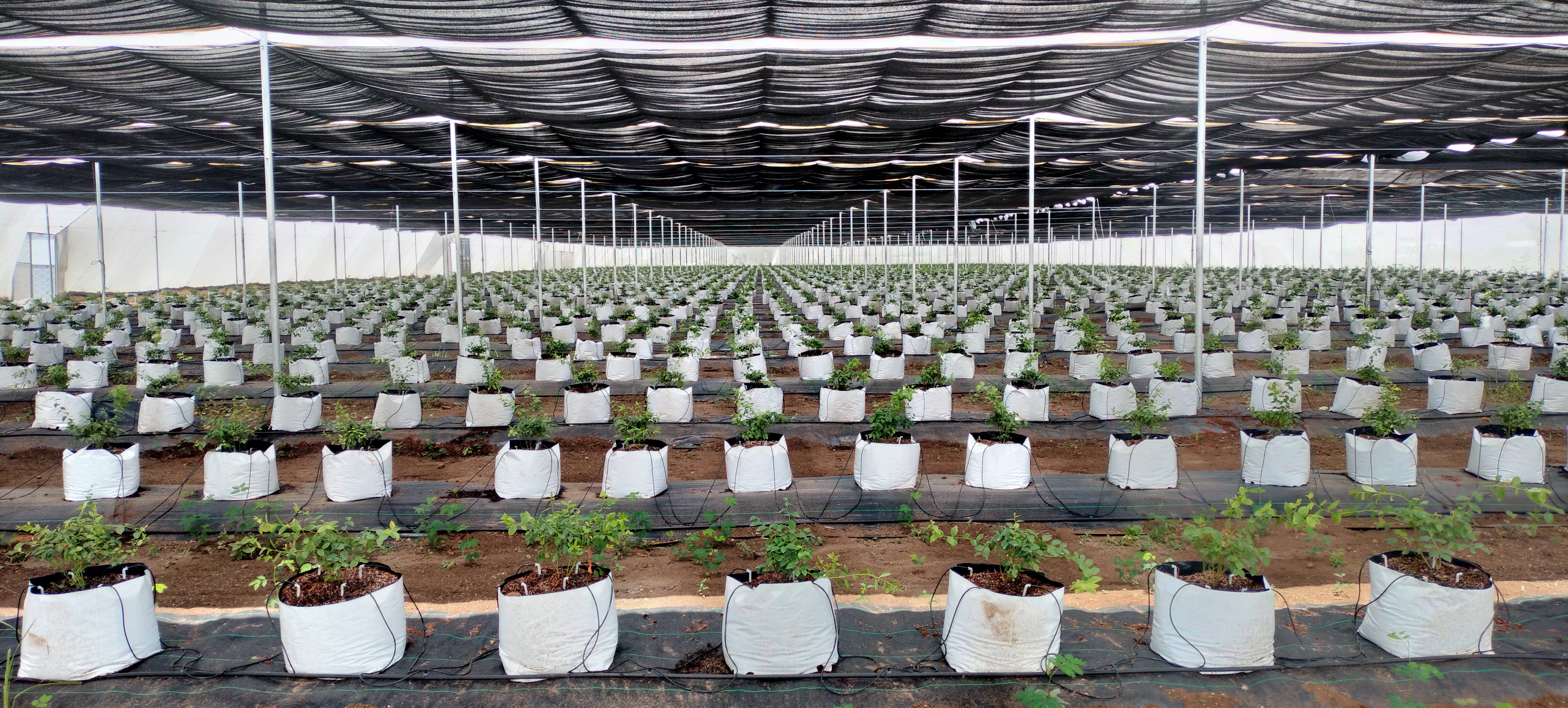
Theam of GI Pipe & Wire Rope Shadenet
is similar to Suspension bridge technology. GI Poles are supported by tension Cables
& load of structure is transmitted from one GI Pipe to another.
with the help of
this technology it is possible to erect long span structures with minimum GI
column supports.
Structural Design of GI Pipe & Wire Rope Shadenet
house
· Three
types of GI pipes are used in structure. Two inch heavy C class pipes at all
corners, two inch medium B class pipes at periphery and two inch light A class
pipes at internal of structure.
· Corner
Poles are supported by four anchor foundations & periphery poles are
supported by two anchor foundations.
· Interlinking
of GI pipes is provided by 6 mm GI hot deep steel core wire rope.
Foundation of structure
· For
Anchor foundation pit of size 0.3 by 0.3 by 1 meter is excavated, anchor &
hold fast is placed into pit and excavated pit is filled with cement concrete
and stones.
· For
corner & periphery pipe foundation pit of size 0.45 by 0.45 by 0.30 meter is excavated and J pin is placed into pit and
excavated pit is filled with cement concrete and stones.
· For
internal pipes pit of 0.45 by 0.45 by 0.60 meter is excavated, GI pipes 0.5 meter is placed into pit and excavated pit
is filled with cement concrete and stones.
Cladding materials of structure
· At
top layer of structure Monofilament net, Insect Net or Tape net are used. Type of
Net depends on type of crop & climatic conditions of site.
· At
Side Insect net and additional tapenet is used to take control over Insects and
sunrays.
· At
Bottom of Structure woven fabric is installed to optimize carbon effect into
structure. Due to woven fabric Carbon dioxide level is increases in nethouse,
which is helpful for plants growth.
Structural Advantages
· It
is First Net house structure in India whose structural analysis is done on most
advanced Ansys cad software. Analysis includes Wind load analysis, Crop load
analysis, Hail load analysis & bending analysis of GI pipes.
·
Custom Design Structure for Irregular Farm Shapes to Optimum USE of
Field.
·
Made of ISI GI PIPES and Hot deep
GI Steel Core Wire Ropes.
·
Design to meet International
Standards, withstand wind speed upto 120 km/hr.
·
Crop Protection from High Radiation, Strong Wind & Hail Storm.
·
Maintenance Cost of GI Pipe & Wire Rope nethouse is much lesser than
Pipe Nethouse & Polyhouses structures.
· Structure has highest net fitting strength
than any other structures. We use Self Locking Hdpe
Net fixing pins for Fastening a Net. Due to Self Locking HDPE Pins load
carrying Capacity of Structure Increases. Picture shows Heavy Hail storm over
the structure and movement of person over shadenet for cleaning purpose.
·
With Wider Span, (6 meter by 8 meter & 5 meter by 8 meter) and due
to 4 m height inter cultivation
operations become easy by Tractor.
· Cost per Acre of GI Pipe & Wire Rope
Structure Starts from 8.5 lakhs which is much lesser than cost of Pipe Nethouse
which is 18 lakhs & cost of polyhouse structure which is 40 lakhs.
Structural Stability Analysis
· Structural Stability Analysis is done by India’s
Reputed Structural Design firm IDAC on most advanced Ansys Cad Software.
· Analysis
includes wind load analysis upto 200 kilometre par hour. Crop load analysis
upto 25 kg par square meter, Hail load analysis of structure & Bending
Analysis of GI Pipes.
· High
Hailstorm is enough to damage crops, To avoid this we build a stronger
structure which will stand in any natural conditions. Our structure is already
designed to withstand 120 km/hr wind, and we had experience of hail storming at
various region on our structure (shown in photograph).
· We
tested our Shadenet structure under hail load, in which 110 kg hail on top of
structure, there is no any damage to structure. Test shows satisfactory results
on which our structure seems stronger than any other structures.
Features in Nethouse - Rectractable Net
· Internal Retractable nets downgrade’s temperature around 10 degree celcius in Nethouse.
· It is Very Effective Technique to Control
High Radiation temperature under Nethouse.
·
Retraction speed of Net is less than a minute.
Features in Nethouse - Trellising Support System
· Structure have its self crop supporting system.
· 3mm & 2mm Hot Deep Galvanized Steel
Core wire ropes are used for Trellising.
·
No additional Bamboos, stakes, wooden balli, wires are required to
support crop.
Features in Nethouse - Polytunnel
· Polytunnels are Made with Galvanized Iron
Framework.
· Maintain Temperature at Night.
· Protection of seedlings & plants from
Rainfall.
· In Day time Poly Film will be raised by
handle to provide sufficient light to seedlings & plants.
· It is Efficient Technique to grow Quality
Seedlings & plants.
Crops Under Nethouse are Cucumber, Capsicum, Orchid, Strawberry, Tomato,
Betel Leaf, fenugreek, spinach, lettuce, coriander, red cabbage, pak choy, taro
leaves, Chinese cabbage, broccoli, red lady finger, blueberries etc.
Comparative of Jaihind Nethouse & Other Pipe Nethouse
· Cost
par acre of Jaihind Nethouse is Rs. Eight Lakh Fifty Thousand Onwards &
Cost par Acre of Pipe Structure is Rs. Sixteen Lakh Fifty Thousand onwards.
· At
top of Structure In Jaihind Nethouse we use Monofilament or Insect Net with
five years UV degradation warranty.
· In
periphery of Nethouse we use Insect Net 40 Mesh with five years UV degradation
warranty.
· Also
at periphery we use additional tapenet which is laid over Insect Net to control
high radiation coming from side Inclination.
· At
bottom of Structure HDPE woven Plastic Film 140 GSM is installed due to this
carbon dioxide level in structure gets increase, helps for growth of plants.
· In
Jaihind Nethouse for Fitting of nets we use HDPE Net fixing Pins & HDPE
Wire, Due to Self Locking HDPE Pins load carrying Capacity of Structure
Increases.
· In
Jaihind Nethouse we use 2 inch GI Pipes having wall thickness 4.5 mm for Corner
poles, 3.6 mm for peripheral poles, 2.9 mm for Internal poles. In pipe shadenet
thickness of pipes is 2.0 mm.
· Grid
Size of Jaihind Shadenet is 6 by 8 meter, 6 by 9 meter & 5 by 8 meter, due
to larger grid size Inter cultivation operation become easy with Tractor. In
pipe shadenet Grid sizes are 6 by 4 meter & 6 by 6 meter.
· For Interlinking of Pipes we use 6 mm Hot Deep
Steel Core Wire rope.
· We
provide 1 meter deep dual anchor foundation for corner & peripheral poles.
· Wind
Withstand capacity of jaihind nethouse is upto 120 km/hr & wind withstand
capacity of pipe nethouse is 105 Km/hr.
· Additional
Crop trellising system cost in Jaihind Nethouse is around 20 rupees par square
meter & In pipe Nethouse trellising system cost comes around 35 rupees par
square meter.
List of our few projects
· Vinayaka
Farm, located in barisadri Rajasthan area of Nethouse is 24 acers.
· Mahyco
seeds, Jalna area of Nethouse is 15.46 acers.
· Sahyadri
Farms, Nashik area of Nethouse is 8 Acers.
· Varaahi
Farms, Chalisgaon area of nethouse is 5.5 acers.
· Madhuban
Nursery, Barshi, Solapur area of nethouse is 5 acers.
· Rise
N Shine, Their, Pune area of nethouse is 3.25 acers.
· Delhi
Gymkhan club, this Site is located near PM House.
· Krishi
Vigyan Kendra Narayangaon & Krishi Vigyan Kendra Baramati.
For more information Click Here